.png)

Thinking About a Career in Counselling? Start Where You Are.

People come to counselling training for all sorts of reasons.
Perhaps people have always talked to you. Perhaps you've worked alongside people in health, education, care or another helping profession and become curious about counselling. Or perhaps you're looking at your working life and thinking that you want something different.
This might be your first career. It might be your second, third or even fourth.
You don't need to have followed one particular route to begin exploring whether counselling might be part of what comes next.
Start Where You Are
One of the things we hear from people considering counselling training is that they don't know whether their existing experience is enough.
Sometimes they've worked with people for years but don't have counselling qualifications. Sometimes they have academic experience but very little experience of therapeutic work. Others are returning to learning after a long time away and aren't quite sure what that will be like.
We don't expect everyone to arrive at the same starting point.
What matters is working out where you are now, what you already bring, and what you need to develop next.
That's why we talk with people before they join our qualifying training. Entry requirements matter, but so does readiness for the kind of learning that counselling training involves.
You Don't Have to Arrive as a Counsellor
Wanting to help people can be part of what brings someone to counselling training. But becoming a counsellor asks for more than being a good listener or the person other people naturally turn to.
You'll begin to explore what happens in relationships. You'll encounter theory, ethics and different ways of understanding human experience. You'll practise counselling skills and reflect on what happens when you use them. You'll notice your assumptions, your responses and the experiences you bring into the room with you.
And gradually, you'll begin developing a practice that is your own.
That development doesn't happen all at once. Nor do we expect it to.
Learning to Become a Counsellor
At Training for Counsellors, our learning is relational, experiential and professionally rigorous.
We bring theory into the room and find out what happens when it meets real people and real practice.
We learn in conversation. We explore. We practise. We reflect. And we get curious.
As training progresses, clinical experience develops alongside learning rather than being something that happens after you've learned everything first. What you encounter in practice can come back into the training room and become part of the live curriculum of learning.
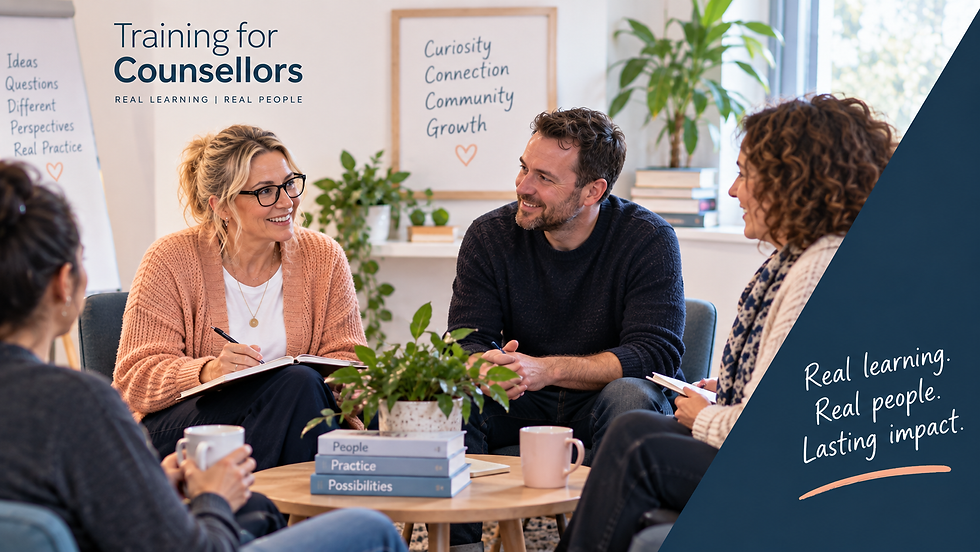
Our groups are intentionally small because we think relationship matters in counselling training.
Learning alongside other people gives you opportunities to encounter difference, practise relationship, receive challenge and feedback, and discover more about yourself as a practitioner.
Our approach is experiential, anti-oppressive and neurodivergence-affirming, with different ways of engaging with learning built into how we teach.
We're not trying to produce counsellors who practise exactly as we do.
We want you to become increasingly able to think about what you're doing, understand why you're doing it, reflect on its impact and, eventually, stand in your own practice.
Perhaps You're Not Ready for Qualifying Training Yet
That's okay too.
Sometimes the next step is simply finding out more.
An introductory counselling or listening-skills course can offer an opportunity to explore what it is like to listen differently, become more aware of how you communicate and begin encountering some of the ideas that underpin counselling.
For other people, previous learning and experience may mean that a different starting point is appropriate.
You don't need to work that out alone. We'd much rather have a conversation about where you're starting from than have you enrol on training that isn't right for you.
Is Now the Right Time?
Counselling training asks something of you.
There is academic learning, certainly, but there is also personal reflection, skills practice, feedback, supervised clinical work and the gradual integration of theory, ethics and practice.
It can sit alongside work, families and busy lives — many of our students do exactly that — but it deserves to be considered realistically.
You don't need to know yet whether you can do all of it.
You can start by asking whether you're curious enough to find out.
Start the Conversation
If you've been wondering about becoming a counsellor, explore our current counselling courses and find out more about how we teach.
And if you're not sure which starting point is right for you, get in touch.
Sometimes the first step isn't enrolling on a course. It's having the conversation.
Revised: 19 September 2026

Comments